


Too many companies still place their trust in set-it-and-forget-it security tools like firewalls, endpoint protection, and a password manager someone from IT set up years ago. But having tools isn’t the same as truly shoring up your organization’s defenses against real-world threats.
We’ve worked enough incident response cases for businesses that had “all the basics covered” to know.
A cybersecurity maturity assessment answers a different question: not “what tools do we have?” but “how securely does our business operate?”
The following guide explains how maturity is assessed in audits, which frameworks define it, how compliance is related but not quite the same thing, and most importantly, where your organization stands right now.
What is Cybersecurity Maturity?
Cybersecurity maturity is typically a numerical score based on a comprehensive measurement of whether specific security practices are in place and how well they operate.
It’s a bit like quality control. Two factories can produce the same part. One follows a documented process, trains its workers consistently, monitors for defects, and improves based on data. The other gets it right most of the time because the people on the floor do their jobs well.
Both could ship a quality product today. Only one will do it reliably when staff turns over, pressure increases, or something unexpected happens.

Mature security is documented, repeatable, measured, and continuously improving. Immature security depends on the heroics of dedicated (and probably very tired) employees… plus a bit of luck.
The Frameworks That Cybersecurity Maturity Assessments are Designed Around
In order to grade cybersecurity maturity, you need a standard to measure against.
Several frameworks have emerged over the years as industry baselines. Let’s cover the most common ones along with their different focus areas and verticals.
CMMI (Capability Maturity Model Integration)
In Blue Team Alpha’s assessments, cybersecurity maturity scores map back to a five-level scale derived from the CMMI framework, developed by the CMMI Institute.
CMMI was originally built to measure process maturity in software engineering, but its logic applies directly to security operations, which is why we’ve integrated it into our internal scoring methodology for assessments and gap analysis.
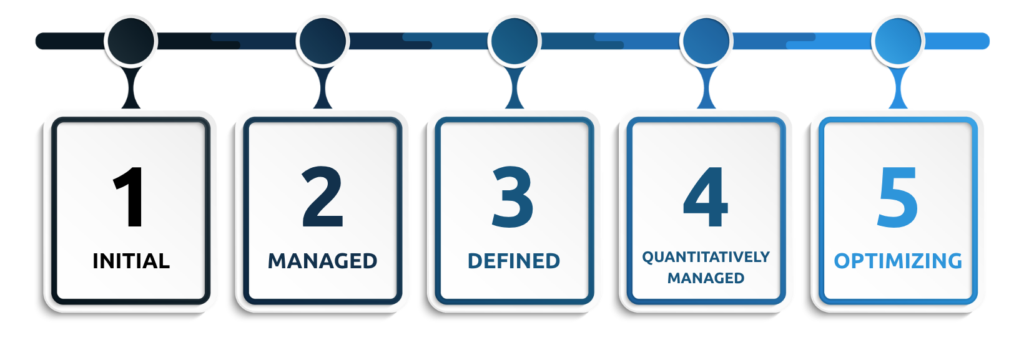
Level 1: Initial – Ad hoc, reactive. Security happens in response to incidents, not by design. No formal policies.
Level 2: Managed – Some processes exist but aren’t consistently applied. Documentation is incomplete. Depends on individuals.
Level 3: Defined – Documented policies and procedures. Consistently followed across the organization. Risk-aware.
Level 4: Quantitatively Managed – Metrics-driven. Controls are measured and monitored using quantitative data. Leadership has visibility into security posture.
Level 5: Optimizing – Continuous improvement. Threat intelligence informs decisions. Security is embedded in culture and operations.
How Do Businesses Tend to Perform on the CMMI Scale?
There is no clear correlation between the size of a company and its level of security maturity. Rather, an organization’s maturity is driven by the effectiveness and consistency of its security practices.
A small company with only a handful of employees could potentially achieve a Level 4 or Level 5 cybersecurity maturity assessment score. While doing so requires a significant commitment to security, smaller organizations often benefit from having fewer systems, processes, and stakeholders to manage.
Conversely, a large organization that has historically treated security as a reactive function or secondary priority may find itself operating at a Level 1 or Level 2 despite having greater resources.
Level 5 is sometimes viewed as unnecessary for certain organizations, particularly if the costs and effort required to achieve and maintain that level outweigh the business benefits. While any organization can work toward Level 5 maturity, doing so requires a strong culture of continual improvement, ongoing measurement and optimization of processes, and sustained executive commitment.
The appropriate target maturity level should ultimately align with the organization’s business objectives, risk profile, regulatory requirements, and long-term strategic goals.
Other Security Frameworks
NIST Cybersecurity Framework (CSF)
Most common within United States
While not unheard of in other countries, NIST is the de facto standard for companies in the US, developed by the National Institute of Standards and Technology. NIST also maps, at least partially, to many other frameworks.
NIST CSF organizes security around six core functions: Govern (new), Identify, Protect, Detect, Respond, and Recover. Its 2.0 iteration (released in 2024) added the Govern function, categorizing risk management as a leadership responsibility.
NIST CSF uses tiers rather than numbered levels (Partial → Risk-Informed → Repeatable → Adaptive), but the concept is the same: how formally are you managing cybersecurity risk?
CIS Controls
Frequently used by SMBs and teams focused on practical operations
The Center for Internet Security’s 18 Controls are organized into Implementation Groups, essentially a prioritized list of security measures. Implementation Group 1 covers basic hygiene. IG2 adds more sophisticated controls. IG3 is for organizations facing advanced threats.
CIS Controls are more prescriptive than NIST CSF, which makes them easier to implement but a lot less flexible. If you want a checklist more than a framework, CIS is often the better starting point.
ISO 27001
Ideal for enterprise organizations, global operations
ISO 27001 is a certification standard, not just a framework. Organizations can be formally audited and certified against it. This is relevant for contracts, partnerships, and operating in certain regions.
It’s more process-heavy than NIST and requires ongoing maintenance to keep the certification active. If a customer or partner is asking for proof of compliance, ISO 27001 is often what they mean.
CMMC (Cybersecurity Maturity Model Certification)
Designed for defense contractors
Required for organizations working with the U.S. Department of Defense. CMMC has three levels and is specifically designed around protecting Controlled Unclassified Information (CUI).
C2M2 (Cybersecurity Capability Maturity Model)
Designed for energy, utilities, and critical infrastructure
10 domains and a tiered maturity indicator scale. Developed in partnership with the Department of Energy.
Maturity vs. Compliance: They’re Not the Same Thing
Sometimes maturity and compliance get tangled up. Similar concepts, different goals and purposes.
Maturity is how advanced and consistent your security practices are. An internal measure of operational quality.
Compliance is whether you meet a specific regulatory or contractual requirement. It’s an external obligation like HIPAA, SOC 2, PCI DSS, GDPR, state privacy laws, and so on.
The critical nuance: compliance doesn’t equal maturity.
A company can pass a SOC 2 audit but score a 1.5 on maturity. Compliant on paper, disorganized or reactive in practice. Audits measure point-in-time evidence. Maturity measures sustained behavior.
Conversely, a mature organization may not hold any formal certifications, but its practices could be meaningfully more resilient than a certified peer that treats compliance as a checkbox.
A complete picture of where you stand requires context. Looking at the whole picture:

- Maturity: How well do you operate?
- Compliance: What are you required to meet, and do you?
- Risk posture: Given what you’re protecting and who might target you, is it enough?
Quick, Self-Led Cybersecurity Maturity Assessment
Use this cybersecurity maturity assessment checklist to score your organization across eight core domains. For each item, rate yourself from 1 to 5 using the CMMI-based maturity levels defined above.
Take your time and answer each question honestly. The goal isn’t a high score, but an accurate one.
1. Governance & Risk Management We have a documented cybersecurity policy that is reviewed at least annually. Leadership has visibility into our current security risks. We conduct formal risk assessments on a defined schedule. Cybersecurity roles and responsibilities are clearly assigned. We have a process for managing risk exceptions. Domain Score: ___ / 5
2. Asset & Vulnerability Management We maintain a current inventory of all hardware and software assets. We scan for vulnerabilities on a regular schedule. Vulnerabilities are prioritized and remediated based on risk. We have a patching policy with defined timelines. Shadow IT (unauthorized assets) is identified and addressed. Domain Score: ___ / 5
3. Identity & Access Control We enforce least-privilege access — users have only what they need. Multi-factor authentication (MFA) is enabled for critical systems. We have a formal process for onboarding and offboarding user access. Privileged accounts are managed separately and monitored. Access rights are reviewed regularly and revoked when no longer needed. Domain Score: ___ / 5
4. Threat Detection & Monitoring We have centralized logging for critical systems. We monitor for anomalous behavior and generate alerts. Alerts are reviewed by a responsible person or team on a defined schedule. We have visibility into network traffic and endpoint activity. Logging and monitoring coverage is reviewed and improved over time. Domain Score: ___ / 5
5. Incident Response We have a documented incident response plan. The plan has been tested (tabletop exercise, simulation, or live drill) in the last 12 months. Roles and responsibilities during an incident are clearly defined. We have a communication plan for internal and external stakeholders. Post-incident reviews happen and findings are used to improve. Domain Score: ___ / 5
6. Data Protection We know where our sensitive data lives (classification and inventory). Data at rest and in transit is encrypted appropriately. We have data retention and disposal policies in place. Backup and recovery processes are documented and tested. Data access is logged and auditable. Domain Score: ___ / 5
7. Third-Party & Supply Chain Risk We assess the security posture of vendors before onboarding them. Contracts include security requirements and right-to-audit clauses. We maintain a list of critical vendors and their access levels. Third-party access is monitored and reviewed regularly. We have a process to respond if a vendor is breached. Domain Score: ___ / 5
8. Security Awareness & Culture All employees complete security awareness training at least annually. Training covers current threats (phishing, social engineering, etc.). We run phishing simulations and measure click rates. Employees know how to report suspicious activity. Security is a recurring topic in leadership conversations — not just an IT issue. Domain Score: ___ / 5
Scoring Your Results
Add up your domain scores and divide by 8 to get your average maturity score.
Total Score: ___ / 40 → Average: ___
1.0 – 1.9 | Initial Security is reactive and ad hoc. Significant exposure. Prioritize foundational controls immediately.
2.0 – 2.9 | Managed Some processes exist but aren’t reliable. Good starting point — focus on consistency and documentation.
3.0 – 3.9 | Defined Solid foundation. Focus on measurement, metrics, and extending controls to edge cases.
4.0 – 4.9 | Quantitatively Managed Strong operational security. Work toward continuous improvement and proactive threat management.
5.0 | Optimizing Benchmark-level maturity. Focus on supply chain, advanced threat detection, and culture.
Important: Also note which domains scored lowest. An average of 3.0 means little if Identity & Access is at 1 and Incident Response is at 1. Domain scores reveal where your specific risk concentrations are.
What to Do With Your Score
A cybersecurity maturity assessment score without a plan is just a number. Here’s how to use it:
If you scored 1–2 (Initial → Managed): Start with the basics. Governance, asset inventory, MFA, and incident response planning should be your first priorities. You can make meaningful progress in 90 days without major spend.
If you scored 2–3 (Managed → Defined): You have a foundation. Focus on making what exists consistent and documented. Identify the two or three domains where you’re weakest and build a 6-month remediation roadmap.
If you scored 3–4 (Defined → Quantitatively Managed): You’re in good shape operationally, so the next step is measurement. Building dashboards and metrics so leadership can see your posture in real time, and third-party validation to confirm your self-assessment is accurate.
If you scored 4+ (Quantitatively Managed → Optimizing): Your business is way ahead of most organizations. Focus on threat intelligence integration, supply chain risk, and ensuring your culture keeps pace with your controls.
A Note on Self-Assessments
This cybersecurity maturity assessment checklist gives you a directional view of your posture. It’s a starting point, not a final answer.
Self-assessments have blind spots, meaning you evaluate what you can see, but the most dangerous gaps are often the ones you don’t know exist. New and developing threat-actor methods, third-party vendor risk, or misconfigured controls that appear functional.
A professional assessment with an external perspective, structured methodology, and working knowledge of your industry’s threat landscape will consistently find things an internal team misses.
If your self-assessment has you concerned, or you’re prepping to meet compliance requirements, a customer security review, or for a board-level conversation about risk, that’s when external validation earns its cost back.
Blue Team Alpha helps organizations assess their current maturity, close critical gaps, and build security programs that hold up to real-world threats. Need help? Get in touch with our team of security experts today.